
THE MISSING MAN TABLE
HISTORY & PROTOCOL
Commemorative ceremonies honoring American POWs and MIAs should be dignified and simple, involving POW/MIA families, returned POWs, and appropriate active-duty personnel, veterans, civic leaders, and other concerned Americans. The Secretary of Defense regularly issues directives to the Service Secretaries suggesting military support for and participation in such ceremonies as part of responsible public awareness on the POW/MIA issue.
The Missing Man Table and ceremony falls somewhere between the fully public and the deeply private. It is held in public or semi-public venues, but can be an extraordinarily emotional and personal experience. Its incorporation into military and civilian events serves multiple purposes: remembering lost or fallen comrades, helping educate the public about the sacrifices some soldiers make, and helping individuals make connections with their sense of history.
In times of war, there is always the possibility that individuals - both military and civilian - will not make it home. While this is traumatic for families and communities, it is made more difficult when the whereabouts and condition of a loved one remain unknown. The Missing Man Table exists to ensure that such individuals are never forgotten at the gatherings of those they served alongside.
THE ELEMENTS AND THEIR MEANING
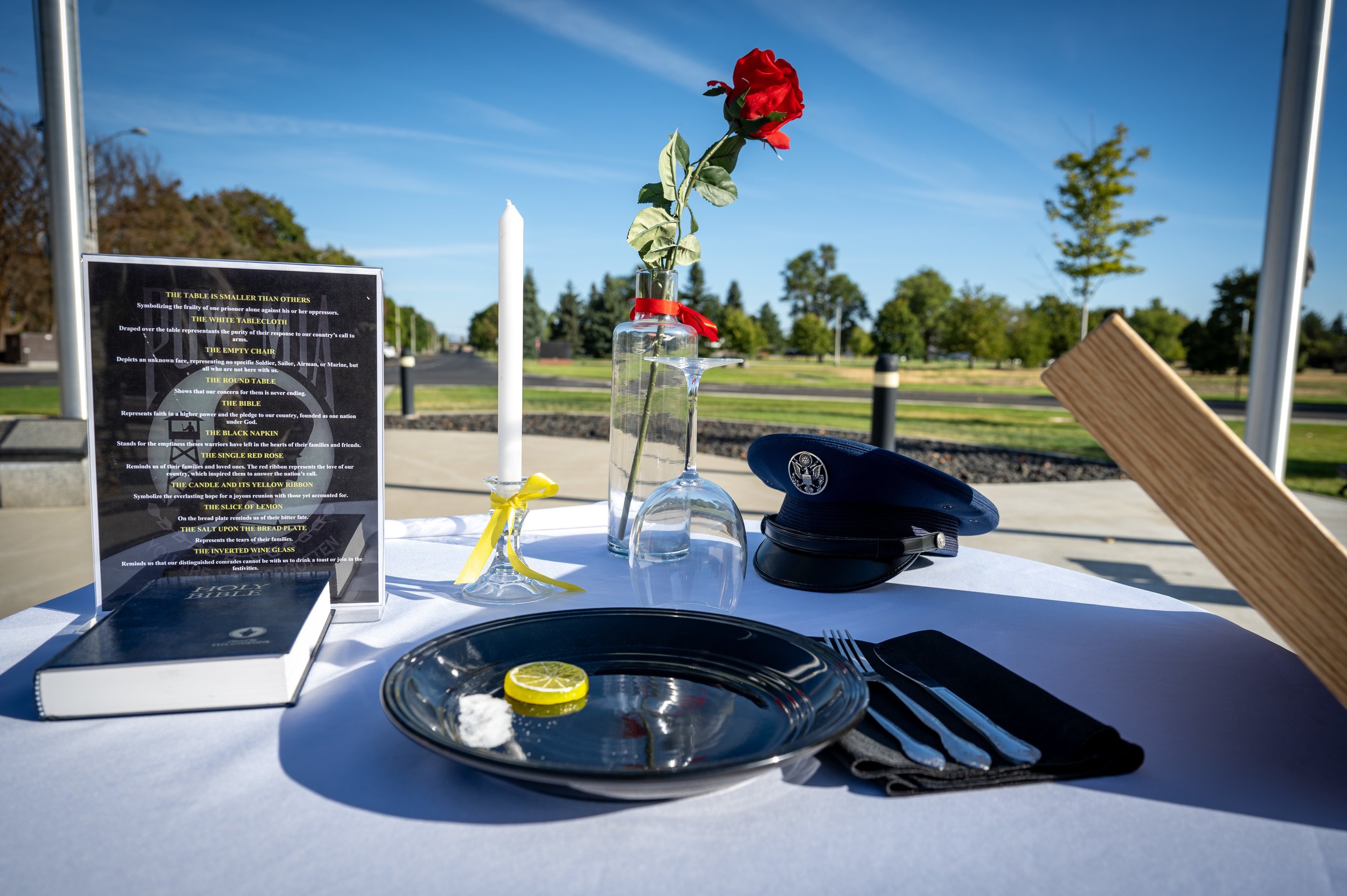
Every object on the Missing Man Table has a specific, intentional meaning. Understanding the symbolism transforms the ceremony from ritual into testimony.
Small Table
Set apart from the others, the table represents the frailty of one prisoner alone against his oppressors.
White Tablecloth
Symbolizes the purity of the prisoner's intentions to respond to the call to duty.
Single Red Rose
Represents the blood they may have shed in sacrifice to ensure the freedom of their beloved United States of America. The ribbon tied to the vase is reminiscent of the yellow ribbons worn on the lapels of thousands who bear witness to their unyielding determination to return our missing servicemen home.
Lemon Slice
On the bread plate, to remind us of their bitter fate.
Salt
Scattered on the bread plate to represent the tears of the families who wait for their loved ones to return.
Inverted Glass
Represents the fact that the missing and their families cannot participate in the toasts.
Empty Chair
The missing soldier is not here.
POW/MIA Flag
Reminds us of over 1,566 Americans still missing from the Vietnam War, and those from other conflicts, who have not returned.
Bible
Represents faith in a higher power and the pledge to our country, founded as one nation under God.
Black Napkin
Represents the unknown fate of our missing, whether they are alive or gone.
Conducting the Ceremony
Candlelight ceremonies honoring American POWs and MIAs should be dignified and simple. Invitations should be sent to state and local dignitaries, veteran leaders in the area, and all POW/MIA and KIA/BNR family members for whom addresses are available.
Regarding the Space Force: In recent years, there have been many questions about whether to include flags and/or a place-setting for Space Force Guardians. It is the opinion of the League that since there are neither any missing nor unaccounted-for within that branch — and we pray there never will be — there is no need to include Space Force materials at the Missing Man Table.
Music Suggestions
Some suggested hymns and patriotic music: "Amazing Grace," "How Great Thou Art," "Bring Him Home" (from Les Misérables), "Let My People Go," "America," "The Star Spangled Banner," "The Battle Hymn of the Republic," and "God Bless America." Discretion is requested in selecting music that reflects positively on the issue and the League's position — no funeral dirges.
Programs
Simple, printed programs should be provided. The program can be typed on a single sheet of paper and folded for printing at any quick-copy establishment. Military installations, local businesses, or veterans and civic groups are often willing, if asked, to co-sponsor the event, print the program, and assist with publicity.
-
Commemorative Candlelight Ceremonies honoring American POWs and MIAs should be dignified and simple, involving POW/MIA families, returned POWs and appropriate active-duty personnel (particularly on military installations), veterans, civic leaders and other concerned Americans. The Secretary of Defense regularly issues directives to the Service Secretaries suggesting military support for and participation in such ceremonies as part of responsible public awareness on the POW/MIA issue.
Invitations should be sent to state and local dignitaries, veteran leaders in the area and all POW/MIA and KIA/BNR family members for whom addresses are available. If the service is being held on a military installation, the base and/or wing commander, executive officer and chaplain should be invited to participate, and all base personnel should be invited to attend.
Programs: Simple, printed programs should be provided. Blank church bulletins are available at religious bookstores. The program can be typed on a single sheet of 8 ½ x 11 standard paper and folded, for printing at any quick-copy establishment. Military bases, posts and stations, local businesses or area veterans and civic groups are often willing, if asked, to co-sponsor the event, print the program and assist with publicity prior to the service. The League’s logo, or a tasteful drawing and calligraphic message depicting faith and determination, can be reproduced to form the program’s cover.
Special Music: Some suggested hymns and patriotic music are: “Amazing Grace,” “How Great Thou Art,” “Bring Him Home” (from the musical “Les Miserables”), “Let My People Go,” “America,” “The Star Spangled Banner,” “The Battle Hymn of the Republic” and “God Bless America.” As music may vary according to region, discretion is requested in selecting music that reflects positively on the issue and the League’s position that the possibility that Americans may still be alive in Southeast Asia is not precluded, i.e. no funeral dirges.
Candles: Candles with drip guards should be provided to each attendee upon entering. Contact a candle distributor and request the candles and drip guards be donated, sold at cost or seek a contribution for this purpose. If such assistance is provided, be sure to mention the company or contributor as a note in the printed program. Candles may be collected following the ceremony or attendees may be requested to relight the candle during their Sunday meal, again remembering our POW/MIA and KIA/BNR personnel and others still missing from our nation’s past wars and conflicts in prayer.
FAQ: In recent years, there have been many questions about whether to include flags and/or a place-setting for Space Force Guardians. It is the opinion of the League that since there are neither any missing nor unaccounted for within that branch, and we pray there never will be, there is no need to include Space Force materials at the Missing Man Table.
-
SAMPLE PROGRAM
COMMEMORATIVE CANDLELIGHT CEREMONY
PRELUDE Organist/Pianist/Other
INVOCATION Chaplain/Minister
NATIONAL ANTHEM/PLEDGE OF ALLEGIANCE Soloist/Chorus/Choir
SCRIPTURE* POW/MIA relative, returned POW, veteran/civic leader
SPECIAL MUSIC Soloist/Chorus/ChoirSPEAKER/MESSAGE Chaplain/Minister, returned POW, military or another special guest
LIGHTING OF CANDLES
(Include roll call of state’s POW/MIAs)
SPECIAL MUSIC Soloist/Pianist/Other
PRAYER Chaplain/Minister
(May be followed by silent prayer)
SPECIAL MUSIC Soloist/Chorus/Choir
BENEDICTION Chaplain/Minister
POSTLUDE Organist/Pianist/Other
*The text of Jeremiah 31: 16-17 is particularly meaningful to POW/MIA families and is most often used in commemorative services:
“Thus saith the Lord, Refrain thy voice from weeping and
thine eyes from tears; for thy work shall be rewarded
saith the Lord; and they shall come again from the land
of the enemy, And there is hope in thine end, saith the
Lord, that thy children shall come again to their own border.”
NOTE: Of special significance is the “Missing Man Table & Honors Ceremony” which incorporates the official covers of the Army, Navy, Marine Corps, Air Force and Coast Guard, plus a civilian cap, placed prominently to symbolize those who were or are POW, MIA or KIABNR, missing and unaccounted for from the Vietnam War and our nation’s wars and conflicts further past.